Summarize this article with
In the Historical Museum of the Palatinate in Speyer, Germany, a Roman bottle of wine from the 4th century is still waiting to be opened. Sealed with a layer of olive oil and a wax stopper, it has come through sixteen centuries without anyone daring to touch it. On one point every expert agrees: this wine passed its peak a very, very long time ago.
Without going quite that far, every wine lover has been through the two classic disappointments. The bottle opened too early, hard and closed, that you feel deserved a few more years. And the one you were saving for a special occasion, which turns out tired, its fruit long gone. Somewhere between the two lies the wine's peak, the moment when it gives the very best of itself. The trick is knowing when it arrives.
What exactly is a wine's peak?
We talk about a wine's peak when it reaches its best balance. The fruit is still there, the tannins have softened, the acidity holds everything together and time has brought out more complex aromas. It is rarely a specific day. It is better to think of it as a drinking window, a few months for a simple fruity wine, sometimes twenty years for a great wine for ageing.
It is also worth restating something obvious that people often forget. The vast majority of wines produced worldwide are made to be drunk within two or three years. Keeping them doesn't make them any better. Only wines for ageing, built to last, really follow the four-stage journey described below.

In its youth, a wine mostly talks about its grape: fresh fruit, flowers, sometimes the oak from its maturation. Reds still have firm tannins that grip on the finish. Then, for the most structured wines (great Bordeaux, Barolo, Hermitage), comes a rather baffling closed phase. The nose goes quiet, the palate seems hard, and you wonder what on earth has happened. Nothing to worry about. The wine is transforming, and you simply need to leave it alone for a few years.
Then maturity arrives. The tannins melt away, the texture turns silky and tertiary aromas take over, with forest floor, leather, truffle and tobacco in reds, and honey, beeswax, hazelnut and dried fruit in whites. This is the peak. For a great wine, that plateau can last a decade. After that comes decline, slowly at first. The fruit fades, the finish shortens, whites pick up notes of walnut or overripe apple. The wine is often still drinkable, but it has lost what made it moving.
Why some wines keep for thirty years and others for two
How long you can keep a wine depends first and foremost on what it has in it. Four components act as natural preservatives, and a wine for ageing always has at least one of them in good measure, without its balance suffering.
The first is acidity. It explains why a Riesling from Alsace, a Savennières Chenin or a Chablis can age for several decades even though they contain almost no tannins. A wine that lacks it will soon seem heavy and tired. In reds, tannins, which come from the skins, the seeds and the wood of the barrels, slow down oxidation and provide the backbone. It is no coincidence that Cabernet Sauvignon, Nebbiolo, Tannat and northern Rhône Syrah produce the longest-lived reds.
Sugar is the secret of great sweet wines. A Sauternes or a Tokaji from a good year will see out a century without flinching, picking up notes of dried apricot, saffron and candied orange along the way. Finally, alcohol protects fortified wines such as Port, Banyuls or Madeira, some bottles of which are still perfectly alive after a hundred years.
Other, lesser-known details count too. A wine from low yields, and therefore concentrated, ages better than a dilute one. A good natural cork lets through a tiny amount of oxygen that accompanies the wine's development, whereas a screw cap preserves more of the fruit. And a magnum ages more slowly than a standard bottle, because there is proportionally less air under the cork. Even the harvest date plays a part, as we explained in our article Harvest 2026: why five days can change an entire wine.
How long to keep wine? Ageing potential by wine type
There is no universal rule, but there are reliable rules of thumb, counted from the vintage year. They vary with the estate and the quality of the year, so for a specific bottle the producer's technical sheet is still your best guide.
How long can you keep red wine? Light, fruity reds (Beaujolais, Loire reds, entry-level Pinot Noir) are ideally drunk between 2 and 5 years, although a well-built Morgon or Moulin-à-Vent will happily last 8 to 10 years. Medium-bodied reds, such as a Côtes du Rhône, a Bourgogne village, a Bordeaux Supérieur or a Chianti Classico, reach their peak between 4 and 10 years. The great wines for ageing (Bordeaux classified growths, Burgundy grands crus, Hermitage, Côte-Rôtie, Châteauneuf-du-Pape, Barolo, Brunello) ask for 10 to 25 years of patience, sometimes more.
How long can you keep white wine? Much longer than most people think, as long as it has acidity. Fruity dry whites, whether Sauvignon Blanc, Muscadet, Picpoul de Pinet or Albariño, are drunk within 1 to 3 years for their freshness. A Chablis premier cru, a Meursault or a white Hermitage comes into its own between 5 and 15 years. As for Rieslings and the great Loire Chenins, they easily go beyond 20 years.
Sweet and fortified wines are the undisputed champions. A Sauternes, a Coteaux du Layon, a Tokaji or a late-harvest Riesling will keep for 10 to 50 years, often longer (to understand why, see our article on late-harvest wines, their characteristics and how they are made). A Vintage Port needs 20 to 50 years, and a Madeira, already deliberately oxidised during its maturation, has practically nothing left to fear.
Champagnes and rosés, finally. A non-vintage brut Champagne is sold ready to drink and is best enjoyed within 1 to 3 years. Vintage Champagnes and prestige cuvées, on the other hand, can age for 5 to 15 years and develop notes of brioche and hazelnut. Most rosés are drunk within 1 to 2 years of the harvest, except for a few more serious appellations such as Bandol or Tavel, which can handle 3 to 5 years.
How can you tell if a wine is at its peak?
Without opening the bottle, there is no way of pinning down a wine's peak with any certainty. Once the wine is in the glass, though, four clues are fairly easy to read.

Colour first. A young red is purple; with age it moves to garnet, then to brick-orange tints that appear at the rim of the glass. A white slides from pale yellow to gold, then to amber. A brown, dull colour usually signals decline. Then the nose. If the developed aromas (forest floor, leather, honey, dried fruit) still sit alongside clear fruit, you are probably at the right moment. If the fruit has disappeared in favour of walnut, stewed notes or vinegar, it is too late.
On the palate, a wine at its peak has integrated tannins, well-knit acidity and a finish that lingers. Tannins that still grip tell you to be patient, and a dry, short palate that you have waited too long. One last test, and a very telling one, is air. A young wine opens up over the hours and benefits from a spell in a decanter. A wine at its peak is expressive straight away. A wine in decline collapses within minutes.
If you own several bottles of the same wine, the simplest approach is still to open one every two or three years and note your impressions in the Oeni tasting sheet. After two or three tastings, you will know exactly when to open the rest.
Storing wine properly so you don't miss its peak
Ageing potential is only a promise. A poor cellar can make a wine age twice as fast as expected and cause it to miss its peak.
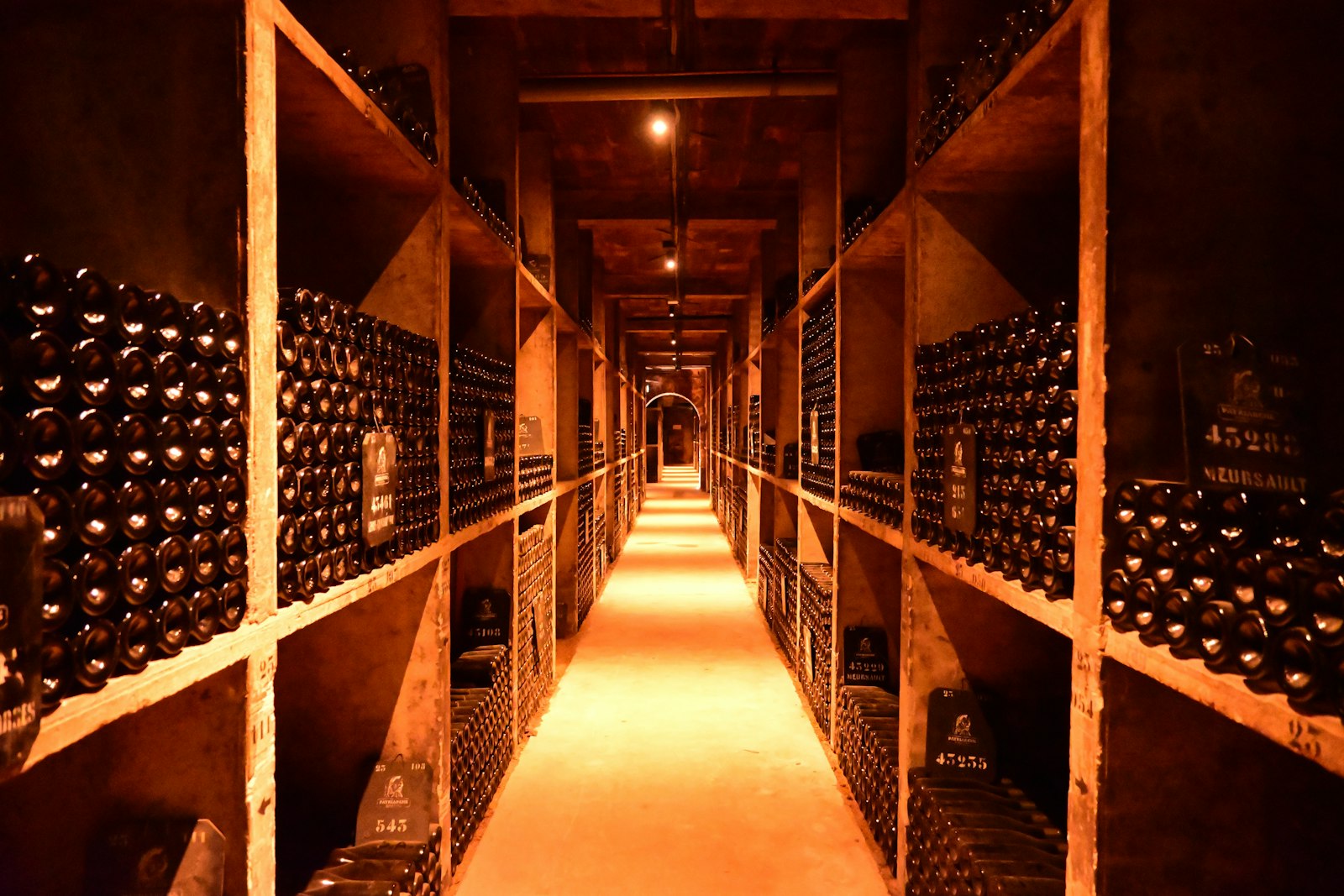
The factor that matters most is temperature. The ideal is around 12 °C, but stability matters more than the exact figure, and a cellar at 15 °C all year round is better than a room that goes from 8 °C in winter to 22 °C in summer. This is actually a good time of year to check yours, as the heating coming back on in October often pushes up the temperature in a cupboard or garage without anyone noticing.
Next comes humidity (70 to 80%, so the corks don't dry out), then darkness, since light is particularly damaging to whites and sparkling wines in clear bottles, and finally stillness, away from the vibrations of a fridge or washing machine. Bottles sealed with cork should be stored lying down so the cork stays moist, while screw-capped ones can stand upright. If you don't have an underground cellar, an electric wine-ageing cabinet does the job very well.
And the 2026 vintage: what ageing potential?
It is too early to judge. The wines are still in tank or barrel, and the first tastings won't take place until spring 2027. The conditions of the year do offer a few pointers all the same. According to estimates from the French Ministry of Agriculture as of 1 October, the French harvest is expected to approach 35 million hectolitres, 2% less than in 2025 and 14% below the average of the last five years, with big differences between regions. Champagne harvested around half as much as in 2025, Burgundy and Beaujolais a third less.
Summer 2026, the hottest ever recorded in France since 1900 according to Météo-France, pushed many estates to start picking as early as mid-August. Small volumes often produce concentrated wines, which argues in favour of ageing. The heat, for its part, pushes alcohol up and acidity down, which works the other way. Those who picked early to preserve freshness could turn out some very fine wines for ageing. The others may well produce round, early-maturing wines that need drinking sooner. More than ever, the name of the estate will count for more than the vintage.
Track your cellar's drinking windows with Oeni
Knowing how long to keep a wine is one thing. Remembering it for every single bottle in your cellar is quite another. In the Oeni wine cellar app, each bottle is recorded with its vintage and its drinking window, so you can see at a glance what is ready to drink, what still needs to wait and what you shouldn't leave much longer before opening.
And if you'd like to understand from the inside how maturation and closure choices prepare a wine for ageing, take a look at Vinae, the participatory wine where you make the decisions.
Your questions about wine peak
How long can you keep a bottle of wine?
It all depends on the wine. Most dry whites and rosés are drunk within 1 to 3 years. Allow 2 to 5 years for a light red, 10 to 25 years for a great red for ageing and several decades for a great sweet or fortified wine.
Can a wine go past its peak?
Yes. Once past its peak, it gradually loses its fruit, its finish turns dry and short and whites pick up notes of walnut. It is often still drinkable, but it has lost its interest.
Do all wines improve with age?
No, and for most of them it is quite the opposite. Only wines rich in acidity, tannins, sugar or alcohol, and concentrated enough, gain from ageing.
Should you decant a wine at its peak?
Rarely. A decanter is mainly there to open up a young, tannic wine. A wine at its peak, being more fragile, can simply be opened an hour before serving, or gently decanted if it has thrown a sediment.
What is the right temperature for storing wine?
Around 12 °C, and above all stable throughout the year. Fluctuations do more harm to wine than a slightly higher but constant temperature.
Good to know:
The best way to get better at tasting is to write down what you taste: colour, nose, palate, and above all what you thought of it. Over time, your notes reveal your preferences far better than any guide. In Oeni, every bottle in your cellar has its own tasting sheet, ready to fill in within seconds.