Summarize this article with
For millennia, wine has held a special place in the history of civilizations. It nourishes the body, but the spirit too. A symbol of celebration, alliance, or sacrifice, it accompanies countless rites around the world. It embodies a deep bond between humankind and the divine.
If articles about the world of wine interest you, download our app on iOS or Android. It gives you access to our wine glossary, our articles, and our innovative solution, designed for every wine consumer and collector.
Wine in Sacred Texts
In the Bible, wine appears very early on. After the flood, Noah plants a vineyard and drinks its fruit. Wine quickly becomes a symbol of blessing and joy, but also of excess. Wine and religion therefore have a complex, ambivalent relationship.
In Judaism, wine sanctifies Shabbat and religious festivals. It represents joy, creation, and the covenant between God and his people. The cup of wine accompanies blessings and brings families together at key moments.
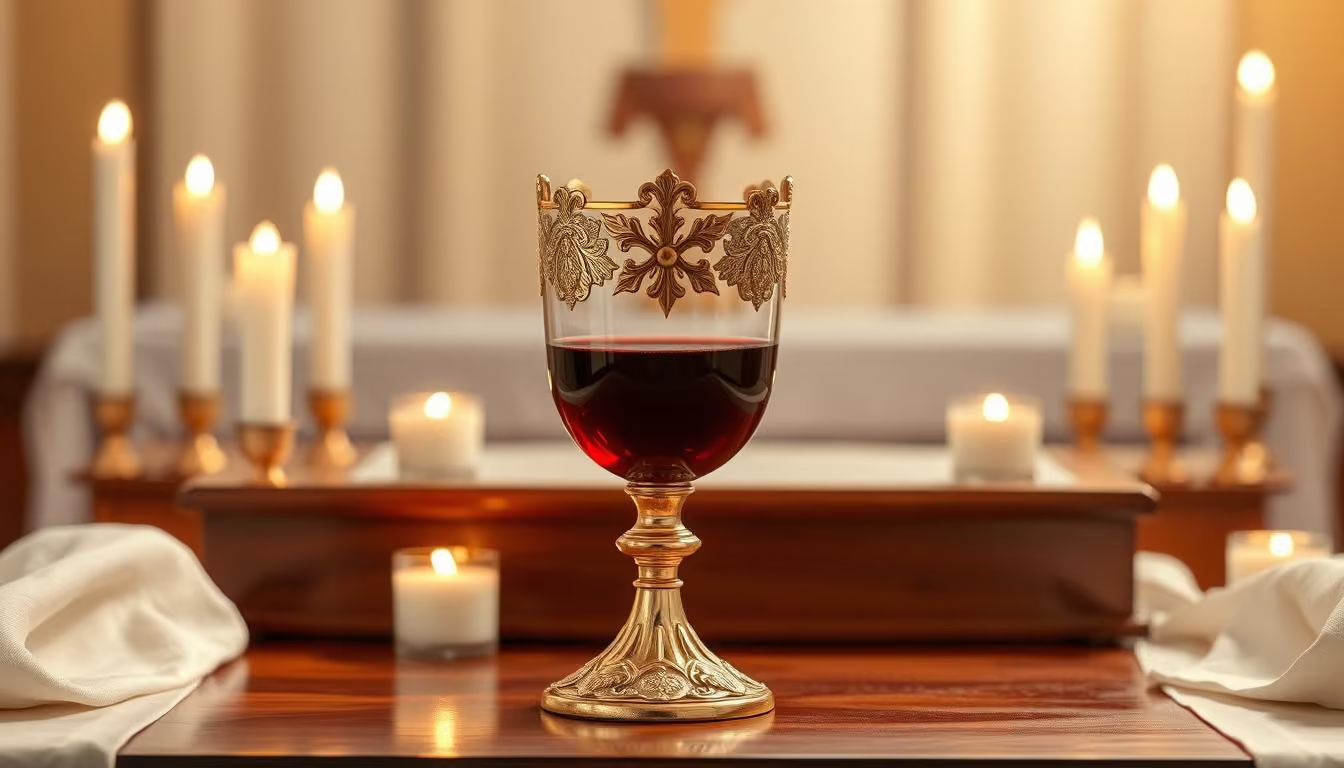
In Christianity, wine holds a central place. At the Last Supper, Jesus offers wine to his disciples as a symbol of his blood. This gesture establishes the ritual of the Eucharist, repeated for two thousand years.
The Origins of Sacred Wine: 5,000 Years of History
The relationship between wine and the sacred didn’t begin with the Bible. It goes back to the earliest civilizations.
Mesopotamia (around 3,000 BC)
The first traces of ritual viticulture appear in Mesopotamia. Wine is offered to the gods in Sumerian temples. It accompanies the dead on their journey to the afterlife, as archaeological excavations have shown, where jars were found in the royal tombs of Ur.
Ancient Egypt
In Egyptian culture, Osiris was associated with the vine. Red wine represented his blood. Pharaohs offered wine to the gods during major ceremonies. Sealed amphorae have been found in tombs, intended to accompany the dead into the afterlife.
Ancient Greece
The ancient Greeks believed wine was a gift from the gods. Dionysus (Bacchus to the Romans) was one of the twelve major Olympians. The Dionysian Mysteries, secret ceremonies held in his honor, blended wine, trance, and communion with the divine. These rites gave birth to Greek theater, and the word “tragedy” itself is linked to these festivals.
Rome: Between Veneration and Prohibition
Rome had a more ambivalent relationship with wine. Bacchanalia (festivals in honor of Bacchus) were banned for a time by the Senate in 186 BC, deemed too subversive. But wine remained central to libations: pouring a few drops on the ground or on an altar to honor the gods was a universal practice in antiquity.
Libation: A Universal Gesture
Libation is one of humanity’s oldest ritual gestures. It consists of pouring a drink, often wine, sometimes milk or oil, as an offering to a deity. It is attested in Judaism, ancient Greece, Rome, Egypt, and many African and Asian cultures.
Wine in the Christian Eucharist
For Christians, wine is not just a liquid. It represents the blood of Christ. It embodies sacrifice and salvation. During Mass, the priest consecrates the bread and wine. The faithful then commune with the divine through these elements.
This wine symbolism rests on the idea of transformation. Earthly wine becomes sacred through the rite. It nourishes the soul as much as the body. This mystery contributes to the spiritual power of the Mass. Wine in religion becomes a channel of grace.
Wine in Judaism: Blessing and Celebration
In Jewish tradition, wine accompanies moments of sanctification. Kiddush, a prayer recited over a cup of wine, opens the Shabbat meal. A blessing is also recited over wine at weddings, circumcisions, and festivals.
Here, wine marks the separation between the profane and the sacred. It symbolizes legitimate joy and commitment. No religious event is celebrated without raising a glass. These spiritual uses of wine create a strong link between faith and fellowship.
Islam and Wine: A More Reserved Relationship
In Islam, wine is traditionally forbidden. The Quran condemns intoxication, seen as a source of disorder and forgetfulness of God. Yet in Sufi poetry, wine becomes a mystical symbol. It represents divine love, spiritual ecstasy, and self-forgetting.
People then speak of wine without a glass, of a cup without drunkenness. This wine symbolism goes beyond the material. It expresses an inner state, a thirst for the absolute. Wine in religion can thus be expressed beyond physical consumption.
Wine in Ancient Traditions
The Greeks and Romans associated wine with the gods. Dionysus for the Greeks, Bacchus for the Romans, symbolized celebration, fertility, and transgression. Ceremonies in their honor blended wine, dance, and spirituality.
Wine then represented a bridge between humankind and the divine. It opened the door to altered states of consciousness. These spiritual uses of wine sought to go beyond human limits. They invited communion with the forces of nature.
Wine in Asian Religions
In certain Buddhist and Taoist practices, wine is offered to ancestors or spirits. It plays a role in purification or prayer rituals. It is used to honor, to give thanks, to ask for protection.
Wine in religion becomes a mediator here. It moves between worlds. It carries human intentions into the afterlife. This wine symbolism varies according to era and school, but it remains present.
The Ambivalence of Wine in Faith
Wine symbolizes life as much as danger. It lifts the soul, but it can also bring you down. That’s why many traditions regulate its consumption. They set rules, blessings, and precise contexts.
This ambivalence strengthens the power of the symbol. Wine in religion is never ordinary. It demands respect, awareness, and moderation. It becomes sacred because it engages human responsibility.
A Living Substance for Sacred Use
Wine comes from a slow, natural, and carefully guided process. Fermentation, aging, and cellaring all echo spiritual cycles. Transformation, patience, maturity: all qualities prized in great traditions.
These parallels explain why wine appeals to religions. It symbolizes alchemy. It embodies an intimate relationship between humankind, the earth, and the sky. This wine symbolism goes beyond doctrine. It speaks to both heart and mind.
In Summary: Wine in 5 Major Religious Traditions
Wine is never neutral in the major religions. Sacred, forbidden, metaphorical, or symbolic, it always involves a relationship between humankind, the community, and the divine.
Today: Between Tradition and Reinterpretation
In a more secular world, wine still keeps its place in certain rites. It continues to unite, to celebrate, and to mark life’s milestones. Some communities are reinterpreting the spiritual uses of wine in step with modern life.
We’re also rediscovering ancient traditions. We’re questioning the meaning of symbols. Wine in religion becomes a bridge between past and present, between the sacred and the everyday.
If you enjoyed this article, feel free to read the next one, "Which wines should you drink young, and which should you age?", which may also interest you!
FAQ
Why is wine used in the Catholic Mass?
Because Jesus, at the Last Supper, took a cup of wine and said to his disciples, “This is my blood.” This gesture establishes the Eucharist, a central sacrament of Christianity. Consecrated wine is considered by Catholics to be the blood of Christ, a transformation called transubstantiation.
What is kosher wine?
Kosher wine is wine produced according to Jewish dietary laws (halakhah). Only observant Jews may take part in its production. It must be supervised by a rabbi and must not contain non-kosher additives. It carries a rabbinical label on the bottle.
Why does Islam forbid wine?
The Quran (surah V, verse 90) considers alcohol an “abomination” because it clouds reason and turns people away from prayer. Intoxication is seen as a loss of control incompatible with submission to God. However, wine is promised as a reward in paradise — without any intoxicating effect.
What is Sufi wine?
In the Sufi tradition (the mystical branch of Islam), wine is a poetic metaphor for divine love. Poets such as Rumi or Hafez use the image of wine and drunkenness to describe spiritual ecstasy and union with God. This wine is never physically consumed.
Do monks still produce wine today?
Yes. Many monasteries in France and around the world produce wine. In Burgundy, the Cistercians laid the foundations of terroir in the Middle Ages. Today, abbeys such as Lérins Abbey (the Côte d’Azur) or Mount Athos (Greece) produce recognized wines. These wines serve both liturgy and sale.
What is the difference between a libation and a sacrifice?
A libation consists of pouring a drink (wine, milk, oil) as an offering to a deity, without consuming it entirely. A sacrifice involves the total destruction of an offering (animal, food) to honor a god. Wine can be used in both contexts.
Does wine have a role in Hinduism?
Grape wine is not central in Hinduism. However, soma (the sacred drink of the Vedas) plays an equivalent role. Liquid offerings (water, milk, juice) are everywhere in pujas. Some Tantric schools use wine in specific rituals.
Good to know:
The best way to get better at tasting is to write down what you taste: colour, nose, palate, and above all what you thought of it. Over time, your notes reveal your preferences far better than any guide. In Oeni, every bottle in your cellar has its own tasting sheet, ready to fill in within seconds.