Summarize this article with
Appellations d'Origine Contrôlée (AOC) are a cornerstone of France's winemaking heritage. With nearly 363 appellations (AOC/AOP) according to the 2025 classification, they guarantee the origin and quality of the wines. But what do these appellations really mean, and why are they important for wine lovers?
What is a wine Appellation d'Origine Contrôlée (AOC)?
The AOC is an official label that guarantees a wine comes from a specific region and adheres to strict production standards.
1. Geographical origin
The AOC certifies that the grapes used to produce the wine come from a defined area. This origin influences the taste and characteristics of the wine.
2. Production methods
Producers must follow precise rules regarding grape varieties, planting density, and yields.
3. Quality control
Before receiving the label, each batch is subjected to a sensory analysis to ensure quality and authenticity.
The importance of wine appellations in France
1. Preserving traditions
Appellations d'Origine Contrôlée protect traditional production methods and promote local expertise.
2. Showcasing terroir
Each AOC reflects the geographical, climatic, and cultural specificities of its region. This allows for unique diversity.
3. Ensuring quality for consumers
AOC wines offer a guarantee of authenticity and quality, which provides reassurance to enthusiasts and collectors.
Major AOC regions and their characteristics
France has numerous wine regions with iconic AOCs. Here is an overview of the most well-known ones.
1. Bordeaux
Bordeaux is famous for its powerful red wines and blends based on Merlot and Cabernet Sauvignon.
- Famous AOCs : Saint-Émilion, Margaux, Pauillac.
- Characteristics : Firm tannins, complex structure, excellent aging potential.
2. Burgundy
Burgundy produces elegant wines, often single-varietal, using Pinot Noir for reds and Chardonnay for whites.
- Famous AOCs : Chablis, Gevrey-Chambertin, Meursault.
- Characteristics : Refinement, expression of terroir, great diversity depending on the vineyard plots.
3. Loire Valley
This region offers a wide variety of wines, ranging from dry whites to light reds and sweet wines.
- Famous AOCs : Sancerre, Vouvray, Chinon.
- Characteristics : Freshness, minerality, diversity of grape varieties.
4. Rhône Valley
The Rhône is divided between the North (Syrah, Viognier) and the South (Grenache, Mourvèdre).
- Famous AOCs : Côte-Rôtie, Châteauneuf-du-Pape, Gigondas.
- Characteristics : Aromatic richness, power, spicy notes.
5. Champagne
Champagne is the only AOC exclusively reserved for sparkling wines produced using the traditional method.
- Main grape varieties : Chardonnay, Pinot Noir, Pinot Meunier.
- Characteristics : Finesse, elegance, delicate effervescence.
Grape varieties in France and their role in AOCs
Grape varieties in France play a key role in the definition of AOCs. Each appellation mandates the use of specific grape varieties.
1. Major red grape varieties
- Merlot : Soft and fruity, it dominates Bordeaux blends.
- Pinot Noir : Delicate, it is the king of grapes in Burgundy.
- Syrah : Powerful and spicy, it reigns in the Northern Rhône.
2. Essential white grape varieties
- Chardonnay : Versatile, it expresses itself differently in Burgundy and Champagne.
- Sauvignon Blanc : Known for its freshness, it shines in the Loire Valley (Sancerre, Pouilly-Fumé).
- Riesling : Found in Alsace, it produces aromatic and mineral wines.
3. Rare and local grape varieties
Some AOCs highlight lesser-known grape varieties, such as Tannat in Madiran or Romorantin in Cour-Cheverny.
How to read a wine appellation label?
Understanding an AOC label helps you choose the right wine for every occasion.
1. Appellation indicated
The appellation is always highlighted, for example, "AOC Châteauneuf-du-Pape."
2. Producer mention
The name of the estate or château is often a mark of quality.
3. Vintage
The harvest year helps assess the wine's aging potential.
4. Grape varieties and terroir
Some labels mention the grape varieties and specific characteristics of the terroir, especially for exceptional wines.
The evolution of Appellations d'Origine Contrôlée
1. The arrival of the AOP
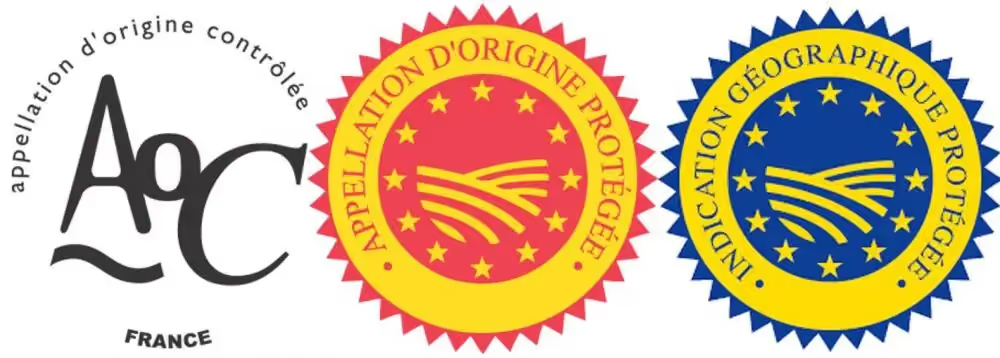
Since 2009, the AOP (Protected Designation of Origin) has been gradually replacing the AOC at the European level.
2. New practices
AOCs are adapting to climate change and consumer expectations, sometimes incorporating organic or biodynamic.
Appellations d'Origine Contrôlée represent a guarantee of quality and tradition for wine lovers. They highlight the terroir, French grape varieties, and the expertise of producers. By understanding these labels, you will be better prepared to choose wines that suit your tastes and every occasion.
In summary: the 5 essential AOCs to know
If you enjoyed this article, feel free to read the next one, "How to host a wine tasting at home", which you might also find interesting!
FAQ
What is the difference between AOC and AOP?
AOC (Appellation d'Origine Contrôlée) is the French national label. AOP (Appellation d'Origine Protégée) is its European equivalent. Since 2009, the two have coexisted: wines are the only products authorized to retain the AOC label even after being registered as AOP.
How many AOCs are there in France?
As of 2025, the Ministry of Agriculture lists 363 wine-related AOC/AOPs in France, representing 3,280 different products (red, white, rosé, sparkling, etc.). This number increases every year with new recognitions.
Who regulates AOCs in France?
The National Institute of Origin and Quality (INAO), which operates under the supervision of the Ministry of Agriculture. Independent certification bodies, approved by the INAO and accredited by Cofrac, carry out field inspections.
Is an AOC wine always better than a non-AOC wine?
Not necessarily. An AOC guarantees the origin and adherence to a set of specifications, not the absolute quality from one producer to another. Some IGP or Vin de France wines made by talented winemakers outperform regional AOCs.
What is the smallest AOC in France?
Château-Grillet, in the Rhône Valley, with less than 4 hectares is one of the smallest AOCs in the world. At the other end of the spectrum, Côtes du Rhône covers approximately 30,000 hectares and 171 villages.
How do I know if a wine is an AOC?
The appellation is always indicated on the label, preceded by the words "Appellation... Contrôlée" or "AOP." The INAO also publishes the complete list of AOCs on its official website (inao.gouv.fr).
Can you make AOC wine using organic farming?
Yes. AOCs are adapting to new practices: many producers are certified organic or biodynamic while still adhering to their appellation's specifications. The two labels can be combined.
Which AOC should I choose for a wine gift?
For a memorable gift: a Bourgogne Grand Cru (Chambolle-Musigny, Gevrey-Chambertin) or a Bordeaux Grand Cru Classé (Saint-Émilion, Pauillac). For a more accessible budget: a Châteauneuf-du-Pape or an Hermitage offer prestige and relative affordability (€25-80).
Good to know:
The best way to get better at tasting is to write down what you taste: colour, nose, palate, and above all what you thought of it. Over time, your notes reveal your preferences far better than any guide. In Oeni, every bottle in your cellar has its own tasting sheet, ready to fill in within seconds.