Summarize this article with
Wine is an integral part of French history. For centuries, it has shaped landscapes, traditions, and the economy. To understand the history of wine in France, you need to explore the origins of the old appellations, those marks of identity that guarantee the origin and quality of a French wine.
The medieval origins of wine appellations
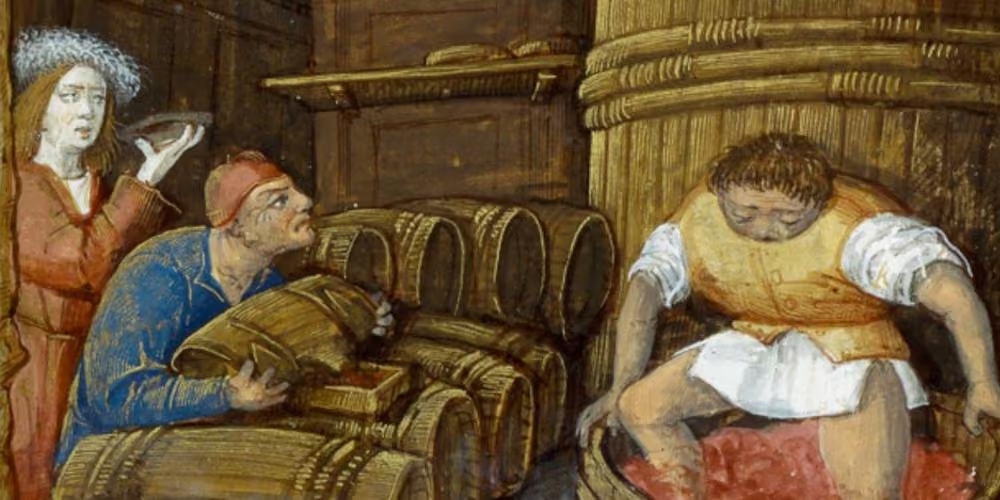
As early as the Middle Ages, certain regions began to stand out for the quality of their wine. Monks played a central role in this process. In their abbeys, they selected the best land, experimented with grape varieties, and established the first quality hierarchies. Regions such as Burgundy and Champagne quickly became synonymous with renowned wines.
Monasteries were already classifying plots according to yield and harvest quality. These early distinctions laid the groundwork for future wine appellations. At the time, labels did not yet exist, but a terroir’s reputation spread through word of mouth, markets, and exchanges between lordships.
Royal recognition of French wine
Over time, the French nobility claimed the best wines for itself. Some crus were reserved for the court. French wine then became a symbol of prestige and elegance. Bordeaux wines soared in reputation in the 14th century thanks to trade with England, while Burgundy wines established themselves at royal banquets.
To prevent fraud, some towns introduced regulations. These early attempts to protect origins foreshadowed the old appellations. For example, it became forbidden to sell wine produced outside the town under its well-known name.
The first classification systems
From the 18th century onward, Bordeaux merchants began classifying estates according to quality. This practice led to the famous 1855 classification, commissioned by Napoleon III for the Paris Universal Exhibition. That ranking is still a benchmark in the wine world today.
Other regions drew inspiration from this model. In Burgundy, winegrowers continued their work of parcel-by-parcel recognition, giving rise to precise designations: village, premier cru, grand cru. These old appellations rest on centuries of observation and know-how.
The phylloxera crisis and the need for regulation
By the end of the 19th century, phylloxera was ravaging French vineyards. This aphid, native to the United States, destroyed vine roots. The crisis pushed winegrowers to replant on a massive scale, often without regard for the old balance.
This disorganized replanting led to a drop in quality. Fraud became widespread. To protect serious producers, the idea of a legal framework became urgent. The state then committed itself to the official recognition of wine appellations.
The birth of the Appellation d’Origine Contrôlée (AOC)
In 1935, France created the National Institute of Origin and Quality (INAO). This body now oversees production rules to guarantee the authenticity of a French wine. It marked the true starting point of modern wine appellations.
The AOC is based on several criteria: geographic boundaries, authorized grape varieties, viticultural practices, yields, and minimum alcohol content. This regulation strengthens the link between terroir and quality. It protects old appellations from imitation.
The evolution of appellations since the 20th century

Since the creation of the AOC, the system has continued to evolve. New regions have gained recognition. Lesser-known areas have managed to showcase their wine history. The diversity of French wine is now on full display.
In the 2000s, European reform introduced the IGP (Protected Geographical Indication) and Vin de France designations. IGP offers more freedom than AOC while still guaranteeing origin. Vin de France allows complete blending freedom, at the expense of precise origin.
These modern developments complement, rather than replace, the old appellations. They give winegrowers different ways to express themselves.
The cultural and economic importance of appellations
Wine appellations are more than just a legal tool. They represent the history, culture, and geography of a region. Every AOC tells part of the story of wine in France.
From an economic standpoint, they add value to wines on international markets. A French wine with a well-known AOC sells for more. It inspires confidence. It carries with it know-how that has been recognized and passed down for centuries.
The contemporary challenges facing appellations
Today, wine appellations face several challenges. Climate change is altering yields, grape ripeness, and aromatic profiles. Some regions are revising their practices. Production guidelines are evolving to adapt.
Meanwhile, younger winegrowers are asking for more freedom. Some choose to step outside the AOC system to experiment with new styles. Others champion old appellations while modernizing their approach.
The tension between tradition and innovation keeps the wine world alive. It ensures its dynamism and its ability to adapt.
Why the history of appellations still matters
Looking back at the history of wine and the old appellations helps you better understand the richness of French wine. Behind every label lies a terroir, a method, a memory.
France has managed to protect its wine regions by creating a model recognized around the world. This protection highlights the work of winegrowers. It encourages excellence. It gives consumers a real guarantee of origin and quality.
If you enjoyed this article, don't hesitate to read the next one, "Maghreb wines: an overlooked treasure worth discovering", which might also interest you!
Good to know:
The best way to get better at tasting is to write down what you taste: colour, nose, palate, and above all what you thought of it. Over time, your notes reveal your preferences far better than any guide. In Oeni, every bottle in your cellar has its own tasting sheet, ready to fill in within seconds.