Résumer cet article avec
For nearly a century, the Institut national de l’origine et de la qualité (INAO) has played a central role in regulating wine in France. This body protects the richness of France’s wine heritage by enforcing strict standards. Its work helps sustain the global reputation of French wines.
An institution created to protect quality and origin
The INAO was founded in 1935 amid fraud and confusion over product origins. At the time, the urgent priority was to protect serious winegrowers from commercial abuse. Before long, the institution became a body for control and certification, responsible for overseeing appellations contrôlées.
Even today, it ensures that precise specifications are respected for each appellation contrôlée, whether for wine, cheese, or other agricultural products. Wine holds a special place here, because France has built much of its reputation on it.
The foundations of French wine regulation
Every wine regulation rests on several criteria defined by the INAO. These include the authorized grape variety, the geographic production area, and the cultivation and winemaking methods. This level of precision prevents drift and guarantees the product’s authenticity.
The INAO does more than define the rules. It regularly inspects domaines and can withdraw an appellation in the event of non-compliance. This role as arbiter gives the institution considerable authority in the wine world.
The process of recognizing an appellation
To obtain an appellation contrôlée, a group of producers must submit a complete application to the INAO. This file sets out the geographic area, production history, grape varieties, and methods used. A consultation phase then begins, followed by scientific analysis and on-site checks.
This process can take several years. The goal is to demonstrate a strong link between the product and its territory — in other words, the famous “terroir.” If the criteria are approved, the INAO forwards its recommendation to the Ministry of Agriculture for official approval.
Appellation contrôlée: a label that stands for transparency
Securing an appellation contrôlée is not enough to guarantee long-term success. Every year, winegrowers must comply with the rules set out in the specifications. The INAO can step in to carry out random or targeted checks. This constant oversight helps maintain fair wine regulation applied consistently and equitably.
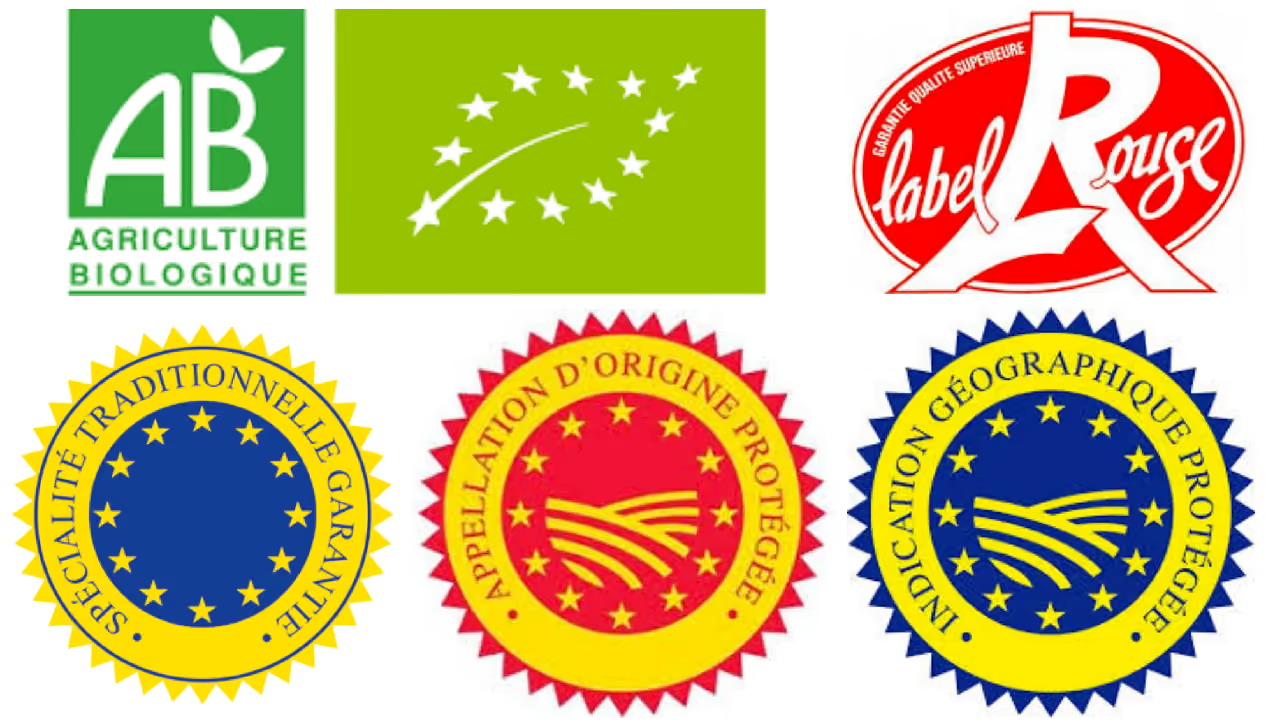
It’s this seriousness that allows consumers, in France and abroad, to trust products bearing the AOC or AOP labels. These acronyms have become essential reference points for anyone looking for a quality wine.
A mission extended to protected geographical indications
Over the years, the INAO has expanded its remit to include Protected Geographical Indications (IGP). Less strict than AOCs, these designations allow for greater flexibility while still regulating geographic origin.
This extension has made it possible to include wines that didn’t meet the demanding AOC criteria but still deserved recognition. In this way, the INAO helps preserve the diversity of French wine, whether it comes from great growths or more modest terroirs.
Modern challenges for a historic institution
Faced with climate challenges and changing consumer expectations, the INAO must constantly adapt its criteria. Winegrowers are experimenting with new grape varieties and organic practices. The INAO works alongside them to evolve the specifications.
This guided flexibility allows French wine to remain relevant and competitive on the global market. The institution doesn’t hold back innovation; it seeks to integrate it intelligently into a shared framework of rules.
The INAO’s educational role
In addition to its control and certification functions, the INAO also plays a role in training and information. It provides resources to help winegrowers better understand wine regulation and guides consumers in their choices. Its work highlights not only producers, but also local know-how.
Many online tools explain how appellations contrôlées and IGPs work. These resources make it easier to grasp the complexity of the French system, which rests as much on tradition as on rigorous organization.
An institution that safeguards wine heritage
The INAO stands as an indispensable player in the wine sector. By ensuring the recognition and protection of appellations contrôlées, it guarantees the continuity of centuries-old know-how. Every certified bottle is the result of collective work between producers, scientists, and representatives of the institution.
Its role goes far beyond simple administrative approval. The INAO embodies a vision of wine as a cultural product, rooted in a territory and carrying a history. Thanks to it, the richness of French wine remains intact in the face of the challenges of the modern world.
If you enjoyed this article, feel free to read the next one, "Wine without grapes: toward a revolution in winemaking?", which might also interest you!